



Best Practice 2
Title of the Practice: Project Based Learning
Introduction
Project/Problem Based Learning (PBL) is an innovative practice used to implement Outcome-Based Education in which students do multiple projects every semester throughout their programme of 4 years. To map the outcomes, Institute has taken 12 defined Programme outcomes (POs) and Programme Specific Outcomes (PSOs) as reference. Out of these, the first four POs and some PSOs are strongly addressed through University syllabus. In order to strengthen the remaining POs/PSOs, to address the higher levels of Bloom’s taxonomy, in view of matching with recent trends of technology and meeting outcomes of PCCOE&R, PBL was introduced by Institute in the academic year 2017-18. PBL encourages students to execute innovative projects by applying their Engineering knowledge at different levels from First year to Final year.
Objectives of the Practice
The Overall objective of PBL is to create a platform to address multiple objectives and to attain the final outcome for students. Major Representative Objectives are to;
- Develop problem solving skills, team skills, critical thinking
- Strengthen POs/PSOs attainment
- Enhance quality of BE projects
- Perceive recent trends in Engineering/Technology
- Design and accomplish research projects
- Nurture research attitude and societal inclination by working on societal/industry problems beyond curriculum
- Inculcate interdisciplinary approach in product development activity and entrepreneurship.
- Learn report writing/prior art of plagiarism.
- Enhance collaboration, interpersonal communication
- Teach professional ethics, values
The Context
PBL is learning-by-doing a range of multiple skills through projects. Students connect with community to identify real life problems. They develop their projects right from First year to address the aforesaid objectives. PCCOE&R provides financial support and an environment conducive for PBL in the form of R&D,innovation labs and other necessary support. This promotes students’ experiences, abilities, learning style and perspective. It also provokes collaborative thinking and investigation. PBL bridges the gap between curriculum and practical needs. Faculty mentors provide insights on various projects, presentation and technical writing skills. Visits to industries, science parks enlighten students on recent trends in technologies and act as content beyond the prescribed syllabus.
Students are assessed progressively and transparently with rubrics, considering idea of the project, problem solving skills, solutions reached social awareness and team spirit. PBL is a hands-on activity that stands apart from traditional models of instruction./p>
The Practice
There is a well-defined documented process and a system that is followed from First year to Final year. The theme behind implementing PBL is to get students ready for industries/research/ entrepreneurship.

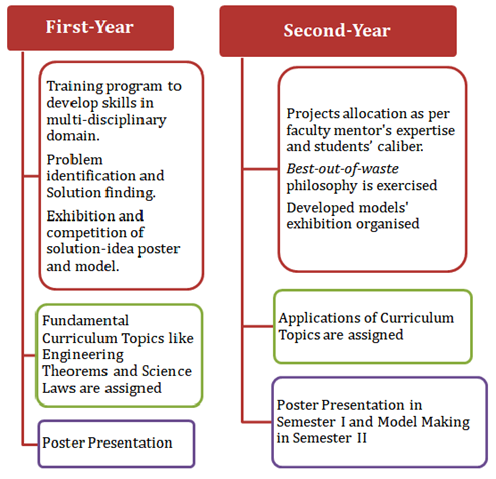
In First year, a training program is organized to develop skills in multi-disciplinary domain. Students identify a problem and showcase their solution-ideas in a poster and a model. An exhibition and competition of these poster and models is organized.
In second year, the Department faculty members allot projects depending upon their own expertise and students’ caliber. Best-out-of-waste philosophy is exercised by utilizing e-waste, scrap, unused components. An exhibition exhibits students learning for developed models.
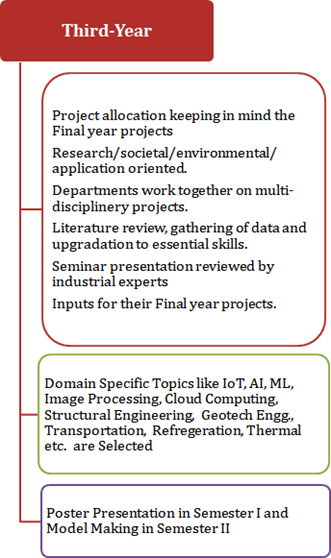
In Third year, projects are allotted keeping in mind the Final year projects (part of curriculum) which are research/societal/environmental/application oriented. In case of multi-disciplinary projects, students and domain expert faculties from different Departments work together. Students do literature review, gather data and upgrade themselves with essential skills. The work is presented as a Seminar, which is reviewed by industrial experts and students get inputs for their Final year projects.
In Final year, know-how gained through PBL unfolds as curriculum project.

The detailed process is as follows;
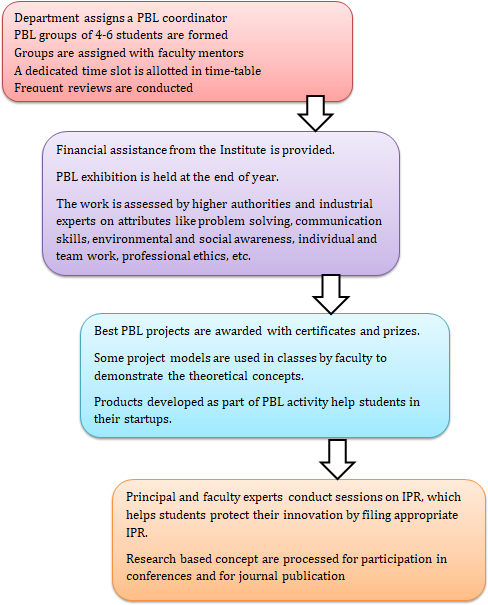
- Department assigns a PBL coordinator.
- PBL groups of 4-6 students are formed.
- Groups are assigned with faculty mentors based on domains. A dedicated time slot is allotted in time table for mentor-group interaction.
- PBL coordinator schedules reviews with other faculties twice in a semester to monitor the progress.
- Financial assistance from the Institute is provided to each project based on recommendation of guide/HoD.
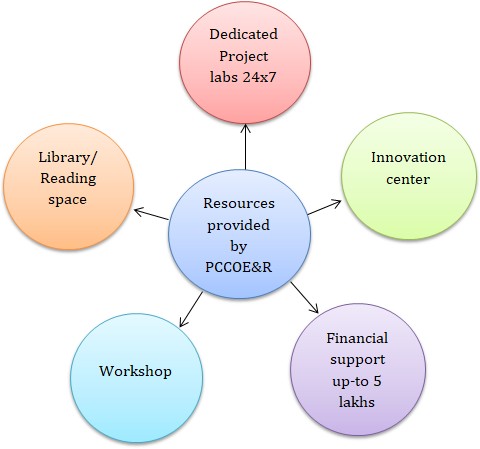
- Students are provided with 24×7 Wi-Fi enabled project labs, innovation center, workshops, library, recent literature, online journals and proceedings
- At the end of year, PBL exhibition is held at institute level where all the departments exhibit/demonstrate their work. The work is assessed by higher authorities and industrial experts on attributes like problem solving, communication skills, environmental and social awareness, individual and team work, professional ethics, etc.
- Best PBL projects are awarded with certificates and prizes. Some project models are used in classes by faculty to demonstrate the theoretical concepts. Products developed as part of PBL activity help students in their startups.
- Principal and faculty experts conduct sessions on IPR, which helps students protect their innovation by filing appropriate IPR. Research based concept are processed for participation in conferences and for journal publication.
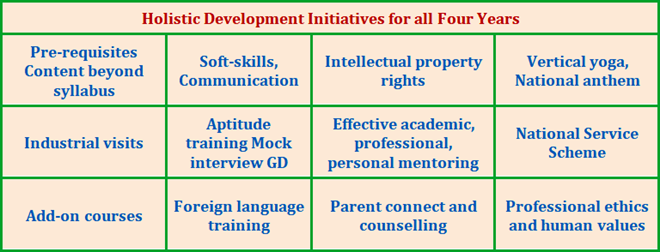
Various resources provided by PCCOE&R are shown below;
Evidence of Success
PBL background is effectively reflected in the overall quality of Final year projects, in research papers published by students, awards won by students in Project competitions, in students’ participating in National level competitions like Hackathon, SAE, Supra, etc. and in overall attainment of POs and PSOs.
The related evidences of success are as follows;
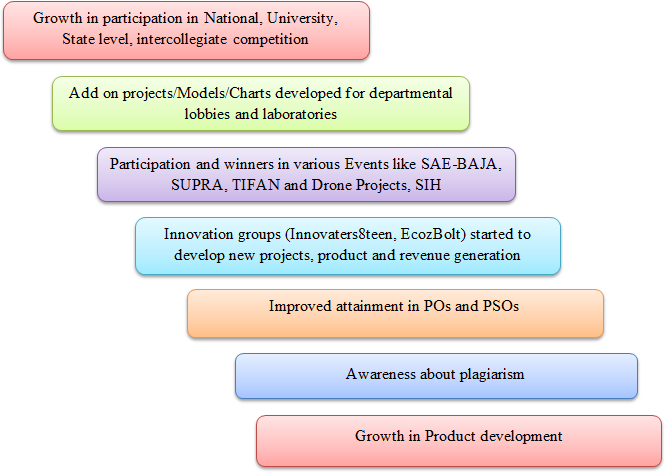
- Students initiated their own innovation groups (Innovaters8teen, EcozBolt) to develop new projects and innovative product and generate revenue.
- Growth in participation in National, university, state level, intercollegiate competition.
- Improved PO attainment (graph in additional information)
- Developed add on projects/Models/Charts. Departmental lobbies and laboratories have been decorated through the PBL activity.
- Formation of different student clubs and participation in various Events like SAE- BAJA, SUPRA, TIFAN and Drone Projects
- Won 4 prizes worth rupees 1 lakh in Smart India Hackathon.
- Winners in TIFAN, SUPRA, GOCART.
- Awareness about plagiarism achieved.
- There is an improvement in number of PBL participation, quality BE projects, research papers, products developed, industry sponsored projects and projects on sustainability as shown below;

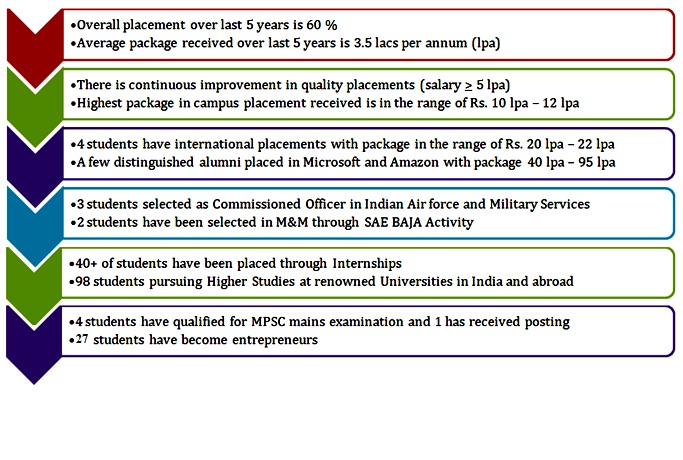
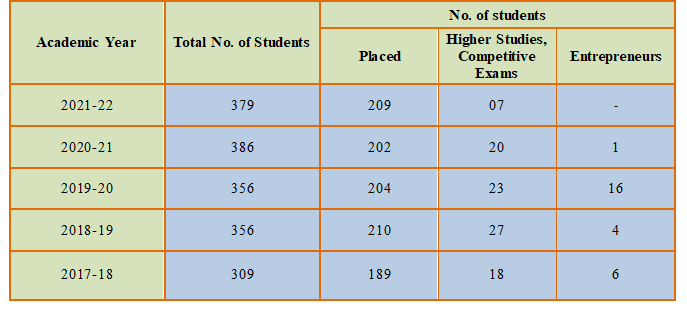
The evidences of success are as follows;
Problems encountered and resource required
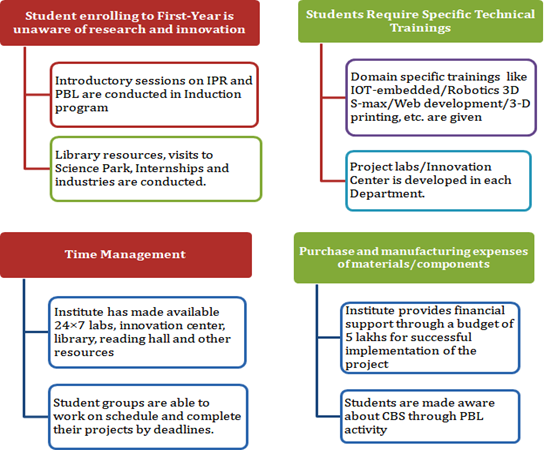
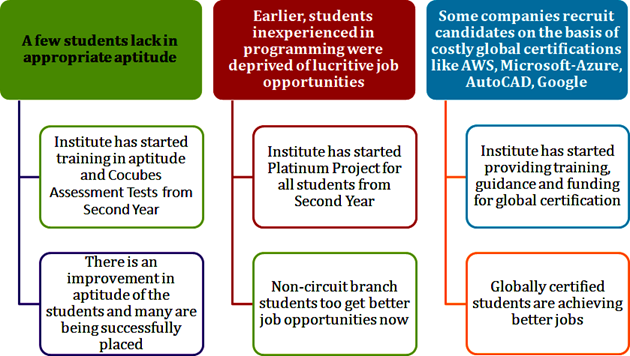
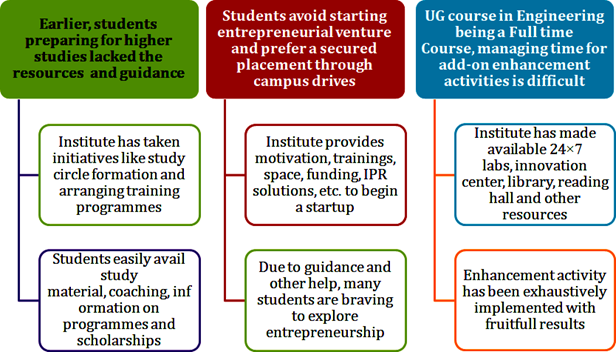
A student enrolling to First year is unaware of research and innovation. It is a task to generate interest about research in their minds. To address this problem, introductory sessions on IPR and PBL are conducted in Induction program. Domain specific trainings like IOT-embedded/Robotics 3D S-max/Web development/3-D printing, etc. are given. Project labs/Innovation Center is developed in each Department. Visits to Science Park, industries, internships and library resources are conducted.
Managing time for the PBL activity and its implementation is challenging. However, with 24×7 availability of project laboratories and innovation Centre, student groups are able to work on schedule and complete their projects by deadlines.
Purchase and manufacturing expenses of materials/components for the development of a working model or product is challenging for students. However, Institute provides financial support through a budget of 5 lakhs for successful implementation of the project. Students are made aware about CBS through PBL activity.